U.S., China begin key trade talks in London,
U.S., China Begin Key Trade Talks in London Amid Global Economic Uncertainty
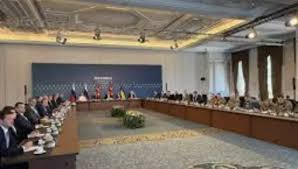
In a significant diplomatic and economic development, U.S., China begin key trade talks in London on June 9, 2025, at the historic Lancaster House. This high-level meeting follows an earlier round of discussions held in Geneva last month, reflecting the urgency both nations feel in stabilizing their strained economic relationship. With global supply chains still recovering from disruptions caused by earlier trade wars, the world’s attention is firmly fixed on the outcomes of these talks. The fact that U.S., China begin key trade talks in London signals hope that some form of economic truce may be extended or reshaped in a mutually beneficial way.
As U.S., China begin key trade talks in London, the symbolic venue of Lancaster House—steeped in political history—adds gravitas to the occasion. While the UK is not directly involved in the negotiations, it has welcomed the development, reaffirming its stance on championing free trade. This neutral location provides a diplomatic setting where both countries can engage in detailed and transparent discussions. The decision for U.S., China begin key trade talks in London underlines a renewed intent to resolve critical trade issues that have escalated into tit-for-tat tariff battles over the past few months, negatively impacting global markets.
At the heart of these negotiations is the dispute over rare earth elements. As U.S., China begin key trade talks in London, one of Washington’s top demands is the reinstatement of rare earth exports from China, which are essential for manufacturing technologies like electric vehicle batteries and military hardware. Since President Trump’s “Liberation Day” tariffs in April, these exports have significantly declined. China, on the other hand, seeks relief from American restrictions on tech access, immigration curbs on students, and tighter regulations on Chinese companies operating in the U.S. The fact that U.S., China begin key trade talks in London highlights how interconnected and complex their economic ties truly are.
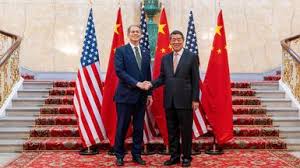
The lead negotiators for the U.S. include Treasury Secretary Scott Bessent, Commerce Secretary Howard Lutnick, and Trade Representative Jamieson Greer. On the Chinese side, Vice Premier He Lifeng is leading the delegation. Their presence emphasizes the importance both countries place on these discussions. As U.S., China begin key trade talks in London, their strategic decisions could influence trillions in bilateral trade. Both sides are under pressure to reach at least a temporary settlement, especially after Trump and Xi’s recent phone call, which both nations described as “positive.” Still, there is a long road ahead, even as U.S., China begin key trade talks in London with cautious optimism.
In addition to rare earths, the broader concern remains tariffs. Earlier this year, the U.S. imposed a 145% levy on Chinese goods, to which Beijing responded with tariffs up to 125%. These crippling rates strained businesses on both sides and led to declining trade volumes. As U.S., China begin key trade talks in London, negotiators are expected to review the 90-day tariff reduction agreement from Geneva and potentially explore more sustainable solutions. The talks are being watched closely by multinational corporations and trade analysts who understand that what happens when U.S., China begin key trade talks in London will ripple across global economic systems.
Another layer of complexity is public sentiment and political timing. With President Trump back in office and eager to prove his tough stance on China yields results, the American delegation is unlikely to offer broad concessions without tangible returns. Similarly, China is seeking to secure its technological and trade interests while projecting strength. So when U.S., China begin key trade talks in London, both sides are entering with high stakes and firm expectations. It is a diplomatic chess game, and every word exchanged will be analyzed for strategic implications far beyond the trade room’s closed doors.
The impact of these talks is already visible in China’s export data. Exports to the U.S. dropped 12.7% in May alone, showing the real-time consequences of unresolved trade tensions. China shipped $28.8 billion worth of goods to the U.S. last month, a sharp fall from $33 billion in April. These figures validate the urgency with which U.S., China begin key trade talks in London. Without a renewed agreement or easing of trade barriers, both economies could face further slowdowns, and supply chains could be disrupted even more. Clearly, what happens as U.S., China begin key trade talks in London holds immense significance.
Another aspect of the talks includes geopolitical alliances. While U.S., China begin key trade talks in London, China is simultaneously in discussions with Japan, South Korea, and the European Union to establish trade alternatives and lessen dependency on the U.S. Beijing has proposed a “green channel” for rare earth exports to the EU and is strengthening bilateral ties with Canada. Meanwhile, Britain’s finance minister Rachel Reeves met with both Scott Bessent and He Lifeng on the sidelines, emphasizing the UK’s interest in global trade stability. These parallel efforts show how pivotal the moment is as U.S., China begin key trade talks in London.
Looking ahead, many hope the talks will deliver more than temporary relief. Trade wars have shown to be costly and unsustainable. If U.S., China begin key trade talks in London with sincerity and pragmatism, it could mark the beginning of a more cooperative economic phase. However, the challenges are immense: national pride, domestic politics, and security concerns could derail progress at any moment. As the talks continue, stakeholders worldwide will remain focused on the outcomes. One thing is clear—when U.S., China begin key trade talks in London, the consequences are global, and every decision could shape the trajectory of international trade in the years to come.