


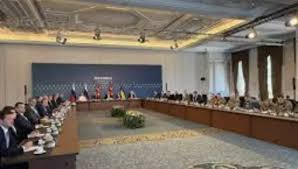
The Russian Ukraine War continues to dominate global headlines, and amidst the relentless aggression and tactical responses, the world witnessed a crucial diplomatic development. On June 2, 2025, officials from both Russia and Ukraine convened in Istanbul, Turkey, for the second round of peace talks. The meeting was held at the iconic Ciragan Palace and lasted just over an hour. Though brief, the session did not conclude negatively, according to Turkish officials. This meeting follows a recent surge in hostilities, including Ukraine’s extraordinary drone offensive, codenamed “Spider Web,” which targeted deep Russian military infrastructure. These developments add urgency and complexity to the Russian Ukraine War, highlighting the desperate need for peace and the many obstacles in achieving it.
The peace talks occur at a time when hostilities are at a fever pitch, with the Russian Ukraine War having escalated through advanced military technology and strategic strikes. Just days before the meeting, Ukraine launched a massive drone assault involving 117 unmanned aerial vehicles. This operation, reportedly supervised directly by Ukrainian President Volodymyr Zelensky, hit four key Russian airfields, inflicting significant damage. According to reports, about 34% of Russia’s fleet of air missile carriers were either destroyed or rendered inoperative. This is one of the most significant attacks on Russian military assets since the beginning of the conflict and marks a turning point in Ukraine’s tactical capabilities. The Russian Ukraine War is no longer confined to traditional battlefields; it has entered a new age of warfare, heavily driven by drone technology and cyber-intelligence.
The offensive named “Spider Web” demonstrated Ukraine’s strategic acumen and technological evolution. Among the aircraft damaged were the Tu-95 and Tu-22 M3 long-range bombers, which are capable of deploying both conventional and nuclear payloads. Additionally, the A-50 aircraft — a crucial airborne early warning system — was reportedly affected. Perhaps most notably, one of the targets was Belaya air base in Irkutsk, Siberia, located over 4,000 kilometers from Ukrainian territory. The sheer reach of this operation signals a dramatic shift in the Russian Ukraine War’s dynamics. Ukraine’s ability to strike so deep into Russian territory not only challenges Russia’s sense of security but also redefines the geographical scope of the conflict.
Despite these hostilities, the very fact that peace talks are being held is a significant development. The first round of talks, also held in Istanbul on May 16, 2025, lasted under two hours and resulted in an agreement for a large prisoner swap. However, the meeting failed to bring any comprehensive ceasefire or diplomatic resolution. This second round aimed to build on that limited progress, although no major breakthroughs were reported. Nevertheless, officials involved emphasized that the discussions did not end negatively, keeping the door open for future dialogue. This sliver of diplomatic optimism contrasts starkly with the brutal realities on the ground in the Russian Ukraine War, where thousands continue to be displaced or killed.
Ukraine’s delegation was led by Defence Minister Rustem Umerov, while Russia was represented by Vladimir Medinsky, a close aide to President Vladimir Putin. These high-profile representations underline the seriousness of the discussions. Analysts suggest that both sides are under increasing international pressure to de-escalate the Russian Ukraine War. Turkey, acting as a mediator, plays a critical role in facilitating these talks, hoping to restore some semblance of stability in Eastern Europe. The Turkish government has consistently advocated for peace and has invested considerable diplomatic capital in trying to end the conflict, even while balancing its own geopolitical interests with both NATO and Russia.
The stakes in the Russian Ukraine War have never been higher. While Ukraine’s aggressive posture underscores its resilience and capability, it also provokes potential escalations that could draw in more global actors. The use of long-range drones and attacks on assets deep inside Russian territory may trigger a fiercer Russian response, making peace harder to achieve. At the same time, Ukraine argues that these strikes are a form of self-defense aimed at crippling Russia’s ability to launch air strikes against Ukrainian civilians and infrastructure. As both sides stand their ground, the war increasingly becomes a battle of attrition, with diplomacy as the only viable long-term solution.
As the Russian Ukraine War rages on, ordinary citizens continue to bear the brunt of the conflict. Entire cities have been reduced to rubble, families torn apart, and economies strained to the brink. Humanitarian aid organizations are struggling to keep up with the needs on the ground, especially as hostilities escalate. This context makes diplomatic efforts like the Istanbul peace talks all the more crucial. They offer a glimmer of hope in a war marked by immense human suffering. But for peace to take root, both Russia and Ukraine must find common ground — a challenge that seems monumental given the current state of affairs.
The “Spider Web” operation has, undoubtedly, shifted the perception of Ukraine’s military strength and capacity to retaliate. But while military victories may boost morale and strategic positioning, they rarely replace the necessity of a negotiated settlement. The Russian Ukraine War can only end when both sides agree to put down arms and commit to peace. Until then, the world will continue watching events like the Istanbul talks with cautious hope, praying that they lead to lasting solutions. The conflict’s outcome will not only shape Eastern Europe’s future but also influence global security paradigms in the years to come.
While the second round of peace talks in Turkey didn’t yield a definitive resolution, it served as a reminder that diplomacy is still possible, even amidst ongoing warfare. As Ukraine showcases its evolving military prowess through operations like “Spider Web,” and Russia recalibrates its defense strategies, the need for meaningful dialogue becomes more urgent. The Russian Ukraine War remains one of the most complex geopolitical crises of our time, and only through persistent diplomatic engagement can the path to peace be forged