


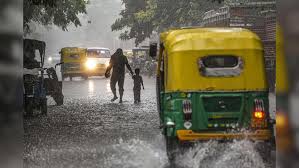
Delhi Weather Alerts have taken on a new urgency this May, as the capital experienced its wettest May on record, with rainfall totals reaching 186.4 mm—nearly nine times the average. This extreme weather was driven by a violent thunderstorm that swept across the region late Saturday night, flooding roads, uprooting trees, and causing massive disruptions at the Indira Gandhi International Airport. The India Meteorological Department (IMD) issued a red alert ahead of the storm, warning residents about severe thunderstorms, gusty winds, and intense lightning. Despite improved conditions on Sunday, the city remains in recovery mode with travel and public infrastructure still struggling to normalize.
The IMD’s Delhi Weather Alerts were spot-on, forecasting the approaching thunderstorm and advising the public to stay indoors. This alert proved crucial as wind speeds soared between 60 to 100 km/h overnight, uprooting over 300 trees and damaging power lines across the capital. The advisory also urged residents not to take shelter under trees or metal structures and warned farmers to suspend any outdoor field work. Intense lightning added to the dangers, making even open areas hazardous. Flights at the Delhi airport faced significant delays, with airlines like IndiGo citing “airside congestion” that continued even after the skies had cleared on Sunday.
According to official data from the IMD, the city’s primary weather station at Safdarjung recorded 81.4 mm of rain in just the past 24 hours. Other regions followed closely—Lodhi Road received 69.6 mm, Palam saw 68.5 mm, and the Ridge area had 69.1 mm. These measurements reinforce the severity of the situation, justifying the level of the Delhi Weather Alerts issued. Remarkably, the previous record for May was 165 mm set in 2008. The new figures not only break that record but have redefined expectations for what May weather in Delhi can look like going forward. This development raises important questions about climate variability and infrastructure readiness.
In addition to torrential rain and strong winds, Delhi Weather Alerts also warned about the dramatic drop in temperature caused by the storm. At Safdarjung, temperatures plummeted by 10 degrees Celsius—from 31°C to 21°C—within 90 minutes between 1:15 am and 2:30 am on Sunday. This sudden cooling was mirrored across the city at monitoring stations like Palam and Lodhi Road. While the respite from the heat may seem welcome, the abrupt changes added to the chaos, impacting both human health and urban stability. Such shifts can exacerbate respiratory issues, increase the likelihood of accidents, and place additional pressure on emergency services.
Click here for morehttps://currentzone.in/wp-admin/post.php?post=242&action=elementor
To understand why the capital faced such extreme conditions, we must look at the science behind it. Experts from the National Weather Forecasting Centre noted that Delhi Weather Alerts were triggered due to a complex interplay of multiple weather systems. Moisture-laden easterlies and southeasterlies from the Bay of Bengal combined with southwesterlies from the Arabian Sea. These interacted with dry mid-level westerlies, creating a perfect storm scenario. Three key systems contributed: a western disturbance over Punjab and Jammu & Kashmir, cyclonic circulations over northwest Uttar Pradesh and West Rajasthan, and a trough aloft in the upper atmospheric levels. These systems aligned to unleash one of the worst May storms Delhi has ever witnessed.
Unfortunately, the consequences have been dire. According to reports, at least 12 people have lost their lives due to the storms that have battered Delhi throughout May. The storm on May 2, which brought 77 mm of rainfall, caused a house collapse in Dwarka, killing four family members. These events prompted a series of Delhi Weather Alerts through the month, including one on May 15 when dust storms originating from Pakistan and northwestern India severely degraded air quality. Another significant alert was issued on May 21, when the city recorded a heat index of 50°C before temperatures dropped by 14°C due to wind gusts that reached 80 km/h.
The infrastructure has taken a heavy hit. Delhi Weather Alerts were accompanied by visuals of waterlogged streets, particularly underpasses like Delhi Cantt, where vehicles were seen partially submerged. Blocked roads have led to traffic jams and restricted emergency response, while power outages have added to the distress of residents. In Bhairon Marg and other key locations, the civic administration struggled to cope with flooding. While the monsoon is still weeks away, the early onset of such intense systems suggests the city needs urgent climate resilience planning. Drainage systems, tree pruning protocols, and disaster response frameworks all need revisiting.
It’s clear that Delhi Weather Alerts are no longer seasonal events to be ignored. The frequency and intensity of these alerts demand that residents, local governments, and infrastructure bodies respond more proactively. Schools, airports, and essential services must be prepared with emergency protocols. The role of technology and timely alerts has become more critical than ever. Mobile-based push notifications, real-time weather maps, and public broadcast systems must be utilized to full capacity. As extreme weather becomes more common due to climate change, Delhi will need to integrate these lessons into urban planning and public health strategies.
The recent events in the capital highlight that Delhi Weather Alerts are now part of a broader narrative involving climate unpredictability, rapid urbanization, and infrastructure vulnerability. May 2025 has proven to be a stark reminder of how cities like Delhi must evolve to face new climate realities. With 186.4 mm of rainfall and counting, the month has not just broken records but also exposed gaps in readiness. Going forward, the citizens of Delhi must heed weather alerts with greater seriousness, while the administration must prioritize sustainable and resilient urban development to protect lives and livelihoods from future storms.