
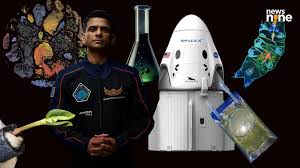
Axiom-4 Mission Launch
Axiom-4 Mission Launch Postponed Due to Weather: India’s Gaganyatri to Soar on June 11
The much-anticipated Axiom-4 Mission Launch, initially scheduled for June 10, 2025, has been postponed by a day due to bad weather. This mission, which will carry India’s second astronaut, Group Captain Shubhanshu Shukla, into space, now targets a revised liftoff time of 5:30 PM IST on June 11. This crucial delay comes after repeated weather disruptions, with this being the fourth postponement. While the delay may frustrate space enthusiasts, it underscores the importance of safety and precision in space launches. The Axiom-4 Mission Launch remains a major milestone in India’s space exploration journey, partnering with global leaders like NASA and Axiom Space.
The Axiom-4 Mission Launch is not just a routine flight—it is a historic leap for India’s space legacy. As the second Indian astronaut to travel into space, Shubhanshu Shukla is following in the footsteps of Rakesh Sharma, the first Indian to go to space in 1984. Now, after over four decades, India is preparing to make another celestial mark through this international collaboration with NASA and Axiom Space. The mission is also dubbed “Mission Akash Ganga” and is expected to spend 14 days orbiting the International Space Station (ISS), participating in scientific experiments and research beneficial for humanity.
Safety remains a critical aspect of every space mission, and the Axiom-4 Mission Launch delay was a necessary precaution. According to ISRO’s official post, inclement weather conditions have made it unsafe to proceed with the launch on the originally scheduled date. Launch Complex 39A at Kennedy Space Center, the iconic site of Neil Armstrong’s Apollo 11 launch, will now see action on June 11 instead. Weather challenges, though common in launches, emphasize the rigorous planning and coordination needed for international space missions. The Axiom-4 Mission Launch timeline reflects not only technological sophistication but also unwavering attention to detail.
Shubhanshu Shukla, the astronaut on the Axiom-4 Mission Launch, is a 39-year-old Group Captain in the Indian Air Force. Trained intensively for this mission, Shukla is currently under pre-launch quarantine at the Kennedy Space Center to prevent any risk of infection. This protocol is vital for maintaining the health of astronauts who will spend two weeks in a highly controlled environment onboard the ISS. In a statement from quarantine, Shukla expressed confidence in the mission’s success. His words have boosted national pride and reinforced the strategic importance of the Axiom-4 Mission Launch in India’s growing space diplomacy.
This is the fourth time the Axiom-4 Mission Launch has been postponed. Earlier dates, including June 8 and June 10, were also missed due to unfavorable weather conditions. Such postponements are not unusual in the space industry, where timing, visibility, wind conditions, and atmospheric pressure are closely monitored. The successful launch of the Axiom-4 Mission Launch is not just about sticking to a calendar; it’s about ensuring that every possible parameter aligns perfectly. Mission planners from NASA, ISRO, and Axiom Space are taking no chances with safety, recognizing the enormous responsibility involved in sending a human into space.
The Axiom-4 Mission Launch marks India’s deeper integration with global space efforts. With NASA providing the launchpad and Axiom Space managing mission logistics, ISRO is positioning itself as a major player in international collaborations. This mission lays the groundwork for India’s future plans, including the ambitious Gaganyaan mission. The Axiom-4 Mission Launch is a test of not only astronaut endurance but also India’s growing influence in space technology and exploration. By participating in manned missions to the ISS, India strengthens its scientific capabilities while also gaining critical experience in long-duration spaceflight operations.
India’s role in the Axiom-4 Mission Launch also signifies an important shift from satellite launching to human spaceflight. While ISRO has successfully launched over 300 satellites and executed complex missions like Chandrayaan and Mangalyaan, the focus is now shifting toward human space missions. This transition is evident in how seriously ISRO is treating astronaut health, module readiness, and weather analytics. The Axiom-4 Mission Launch is more than just a symbolic achievement; it is a demonstration of India’s preparedness for future independent manned missions, potentially placing the country in an elite league alongside NASA, ESA, and Roscosmos.
The spacecraft for the Axiom-4 Mission Launch will dock with the ISS, where Shubhanshu Shukla will conduct experiments and research. These activities will contribute to understanding how the human body reacts to microgravity and confined environments. For India, this is vital research that will inform future space habitats, lunar missions, and even Mars exploration. The Axiom-4 Mission Launch ensures that India is not just a participant in space science, but a contributor to global knowledge. The data gathered could lead to breakthroughs in medicine, biology, and material sciences—all from 400 kilometers above Earth.
As the countdown to June 11 resumes, public excitement around the Axiom-4 Mission Launch continues to rise. News channels, social media, and space enthusiasts across the country are closely tracking updates. This moment brings national pride and international recognition. It’s not just about a launch—it’s about India’s cosmic aspirations. The Axiom-4 Mission Launch will inspire a new generation of scientists, engineers, and explorers. It reflects a modern India that is not only technologically advanced but also courageous enough to reach for the stars. This mission will go down in history as a defining chapter in India’s space journey.