


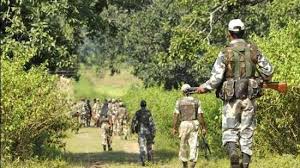
The state of Chhattisgarh witnessed a significant breakthrough in its long-standing battle against Maoist insurgency as security forces gunned down at least 26 maoists killed in major encounter with security forces in a prolonged encounter in the Bastar region. The operation, which reportedly lasted 72 hours, involved the District Reserve Guard (DRG) units from four conflict-prone districts—Dantewada, Kanker, Bijapur, and Kondagaon. State Home Minister Vijay Sharma confirmed the death toll and added that a senior Maoist leader may also be among the deceased, although further identification is underway. This high-impact operation is seen as a critical milestone in curbing Maoist activities that have plagued the region for decades.
This operation comes amid ongoing governmental efforts to reclaim Maoist-affected territories and restore essential public services. 26 Maoists Killed in Major Encounter with Security Forces and the the state has been making steady progress in clearing improvised explosive devices (IEDs) laid by insurgents to deter movement and development. In tandem, infrastructure projects such as schools, hospitals, roads, and communication towers are being built or restored to integrate these remote tribal regions more closely with the state’s administrative and economic networks. Authorities believe that access to education, healthcare, and connectivity can significantly reduce the allure of extremist ideologies and bring long-term peace to the region.
Click here for morehttps://currentzone.in/wp-admin/post.php?post=259&action=elementor
According to Home Minister Vijay Sharma, the encounter was not a random confrontation but a meticulously planned action based on intelligence inputs. The 26 Maoists killed in major encounter with forces who had gathered in a forested area, were reportedly preparing for a major offensive or planning to disrupt development initiatives in the region. The DRG, trained specifically for jungle warfare and counter-insurgency, executed the mission with strategic precision. These forces have been central to Chhattisgarh’s anti-Maoist campaigns, combining local knowledge with advanced training to gain an edge over the guerrilla tactics employed by the insurgents and then kill 26 maoists in major encounter with security forces
What makes this encounter particularly significant is the potential killing 26 Maoists in major encounter with forces. While his identity has yet to be officially confirmed, sources suggest he may be Nambala Keshavrao, alias Basavaraj, the top leader of the banned CPI (Maoist). If verified, his death would represent a major blow to the Maoist command structure. Such high-profile eliminations often trigger a temporary vacuum in leadership, providing an opportunity for security forces to intensify pressure and encourage more surrenders. The government has reiterated its open-door policy for Maoists who wish to lay down arms and reintegrate into society.
The Bastar region, known for its dense forests and tribal population, has long been a battleground between Maoist insurgents and the Indian state. Decades of conflict have resulted in the loss of thousands of lives, disrupted livelihoods, and stunted development. However, the tide seems to be gradually turning. Over the past few years, a combination of improved intelligence, better-equipped local forces, and development-centric governance has begun to yield results. Incidents of violence have declined, and there is a perceptible shift in local sentiment towards peace and progress. Still, much remains to be done to ensure lasting stability in the region.
The central and state governments have emphasized that their approach is not solely military. Security operations are complemented by development packages, rehabilitation schemes for surrendered Maoists, and efforts to engage local communities in governance and law enforcement. Educational outreach and employment opportunities are being expanded to cut off the insurgents’ recruitment base. While the killing of 26 Maoists is a tactical victory, officials remain cautious. The Maoist movement, though weakened, retains pockets of influence and the capacity to regroup. Continued vigilance, community engagement, and development work are essential to maintain and expand these hard-won gains.
The recent encounter in Chhattisgarh’s Bastar region underscores both the challenges and successes in India’s counter-insurgency campaign where 26 maoists killed in major encounter with security forces It highlights how coordinated intelligence, specialized forces like the DRG, and development initiatives can come together to create a robust response to internal security threats. As the nation continues to grapple with the complexities of left-wing extremism, such operations demonstrate that peace is possible when state action is balanced, people-centric, and unyielding in its pursuit of justice and security for all citizens. The road ahead is long, but the direction is finally one of hope and resolve